How to Create a Workspace in a Small Living Room
working from the couch sounds like the ultimate comfort until your lower back starts screaming, and you find yourself staring at a pile of laundry in the background during a crucial Zoom call.
When you live in a small space, combining your living room and your office isn’t just a design challenge, it’s a psychological one. If you aren’t careful, your sanctuary becomes a permanent reminder of your inbox.
The secret to making it work isn’t buying a tiny, uncomfortable desk. It’s about designing a “work zone” that completely disappears when the workday ends. Here is your practical, no-stress guide to building a home office in your living room that actually feels like home.
Phase 1: The “Reality Check” Audit (Before You Buy Anything)
The biggest mistake people make is buying a massive executive desk for a room that only needs a laptop station. Before you shop, define your actual daily reality.
- The 1-Hour vs. 8-Hour Rule: If you only check emails for an hour a day, a slim console table or even a dedicated corner of your dining table is fine. If you are on video calls for 8 hours a day, you must prioritize ergonomics and a proper chair.
- The Screen Check: Do you need dual monitors, or just a laptop? If you need a monitor but have zero desk depth, your secret weapon is a monitor arm (like the Ergotron LX). It clamps to the back of the desk and frees up the entire surface underneath.
Phase 2: Mining for “Hidden Real Estate”
In most small living rooms, you don’t need to “find” space; you just need to repurpose dead space.
- The “Behind the Sofa” Trick: This is the holy grail of small-space offices. Push your sofa away from the wall and place a slim console table (12–16 inches deep) directly behind it. It acts as a desk, hides your legs from the living room’s perspective, and looks like intentional interior design, not a makeshift office.
- The “Dead Corner”: Every living room has that one awkward corner that just collects dust. A compact, shallow desk (like the IKEA MICKE or ALEX setup) fits perfectly here without disrupting the room’s flow.
- The Golden Rule of Placement: Never put your desk in the main walkway. If your partner or roommate has to squeeze behind your chair to get to the kitchen, the layout will cause daily friction.
Phase 3: Scale, Depth, and the “Anti-Cubicle” Chair
A large, black mesh office chair will visually dominate a small living room and make it look like a corporate cubicle. You need furniture that respects the scale of the room.
- Depth Matters More Than Width: You don’t need a 30-inch deep desk. A shallow surface (16–20 inches) is plenty for a laptop, a notebook, and a coffee mug.
- The Chair Strategy: If you don’t sit for 8 hours, use a stylish, supportive dining chair (like a modern Wishbone chair or an acrylic ghost chair) with a seat cushion. If you do need a real ergonomic task chair, look for one with a slim profile, neutral fabric (not black mesh), and use a clear or color-matched chair mat so it doesn’t look like an eyesore on your rug.
Phase 4: The “5 PM Vanishing Act” (Cables & Clutter)
If your living room looks like an IT server room at night, you will never truly relax. The workspace must be able to “close up shop” in under two minutes.
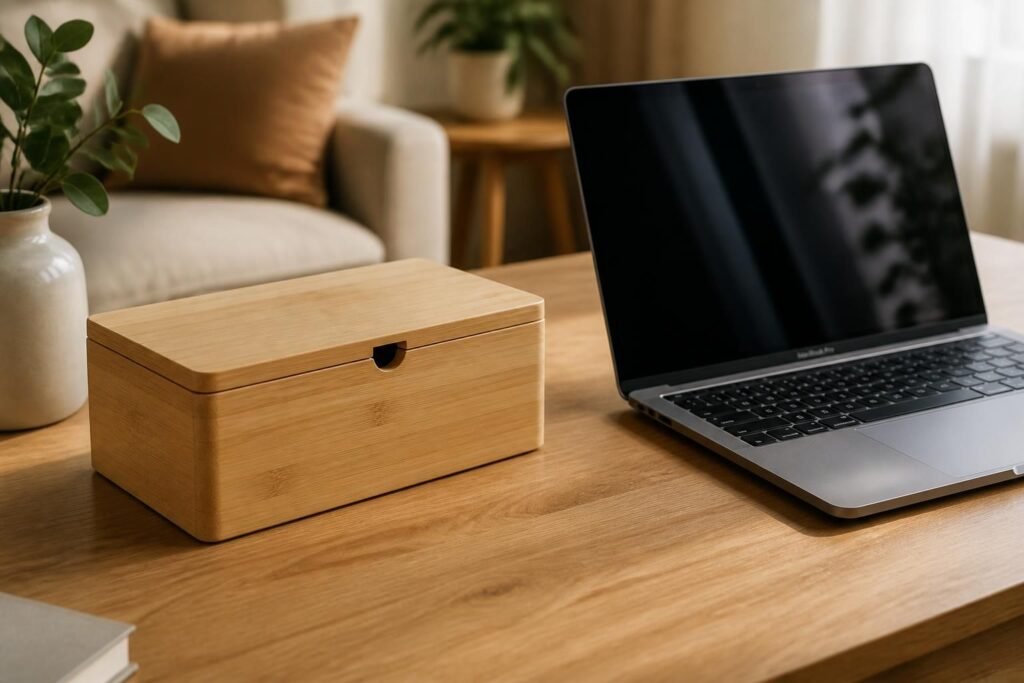
- Tame the Cable Monster: Cables make small rooms look instantly chaotic. Mount a power strip under the desk using heavy-duty double-sided tape. Use a sleek cable management box (like the IKEA SIGNUM or a bamboo alternative) to hide the plug and the messy wire running to the wall. Use adhesive cable clips to route the laptop charger neatly down the desk leg.
- The “Pack-Up” System: You need exactly three things on your desk to keep it clean:
- A lidded box or drawer for chargers, pens, and adapters.
- A vertical file sorter for papers (never let papers lay flat).
- A small tray for your daily items (laptop, notebook).
When the day ends, everything goes into the box. Out of sight, out of mind.
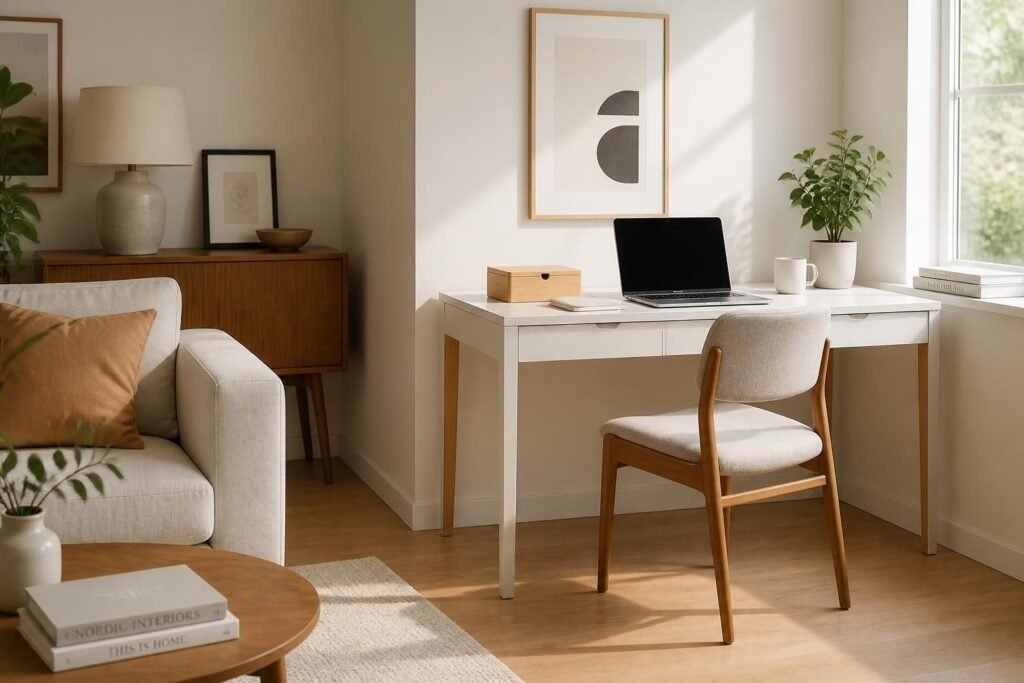
Phase 5: Lighting and the “Zoom Background” Reality
Living rooms are designed for cozy, ambient lighting, which is terrible for working. And if you’re on camera, your background matters.
- Task Lighting is Non-Negotiable: Don’t rely on the dim living room floor lamp. Add a dedicated, adjustable desk lamp (like the IKEA FORSÅ or a sleek BenQ ScreenBar if desk space is practically zero). Place it on the side of your non-dominant hand to prevent shadows.
- Style a 2-Foot “Zoom Zone”: If your desk faces into the room, what’s behind you? Don’t leave it to chance. Style a small 2-foot section directly behind your chair. A tall floor lamp, a trailing pothos plant, and one piece of framed art. That’s all you need to look professional and intentional on camera.
The Quick Reference: Which Desk Fits Your Life?
| Workspace Type | Best For | The Vibe | Watch Out For |
|---|---|---|---|
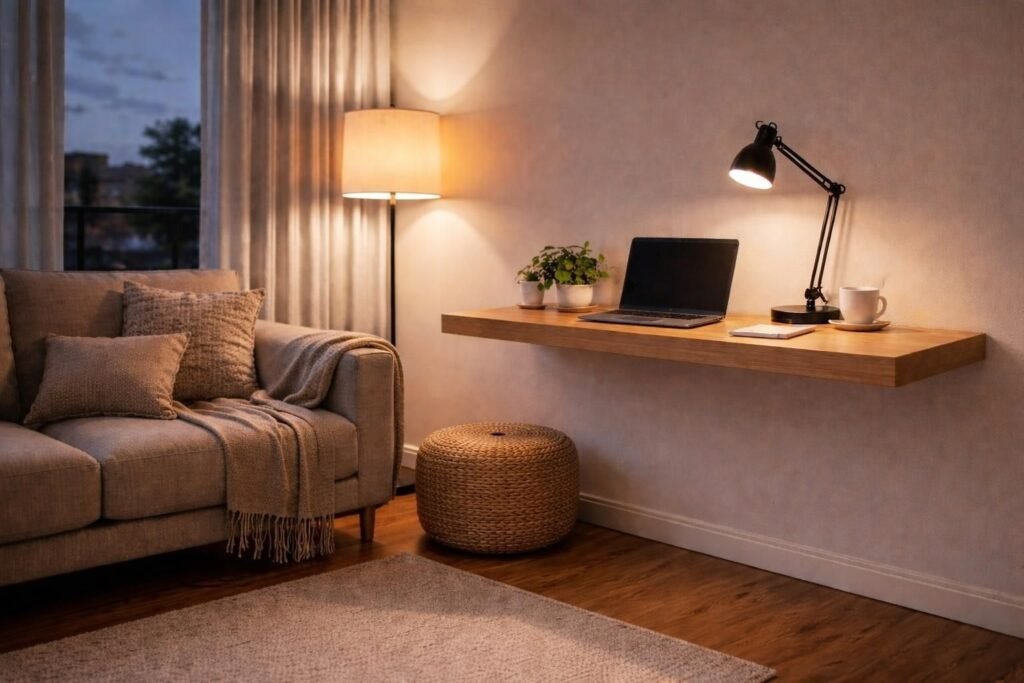
| Wall-mounted / Fold-down desk | Smallest rooms, occasional work | Disappears completely at 5 PM. | Limited storage; requires drilling into studs. |
| Slim writing desk (16″ deep) | Daily laptop work, minimalists | Clean, simple, doesn’t block the room. | Papers pile up fast if you don’t use a vertical sorter. |
| Console table behind sofa | Open-plan rooms, dual-purpose layouts | Looks like high-end living room furniture. | Needs careful cable routing; chair must tuck in fully. |
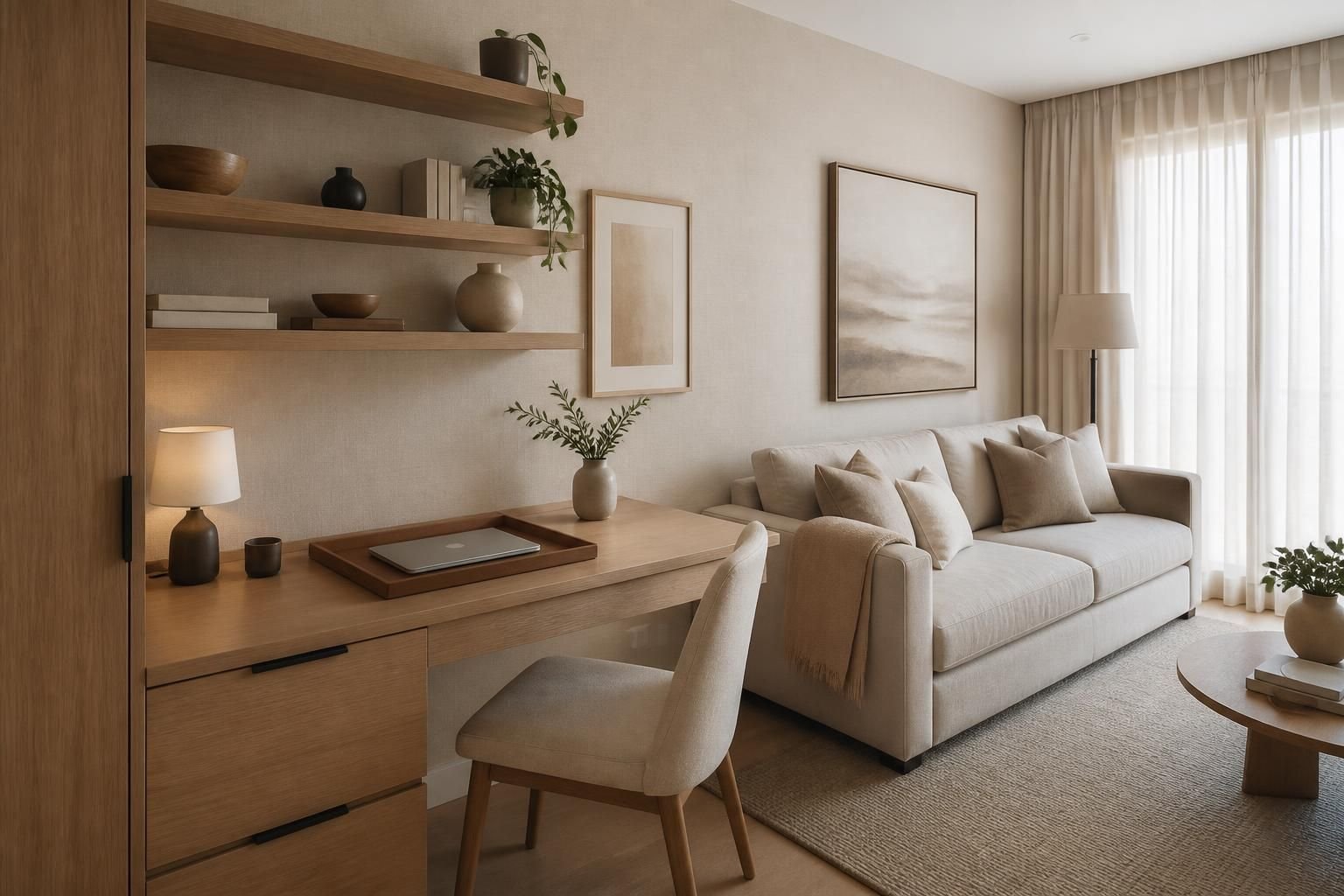
| Secretary / Cabinet desk | People who need to “hide” their work | Close the doors, and the office is gone. | Can feel cramped if you use large external monitors. |
| Dining table (Temporary) | Occasional deep work, zero budget | No extra furniture needed. | Terrible for posture long-term; hard to keep clear of daily life clutter. |