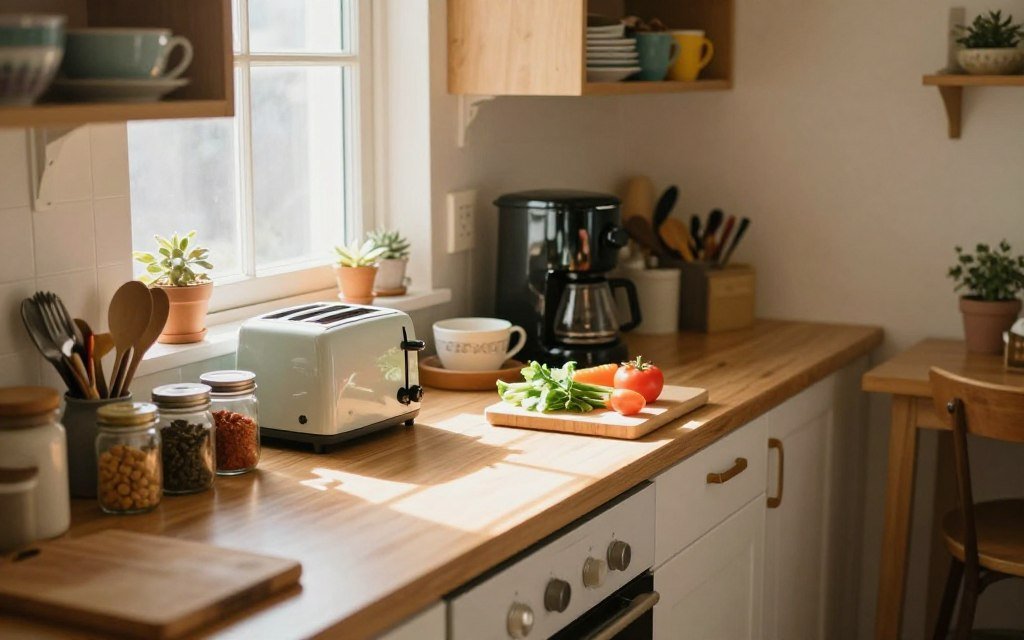
Why Small Kitchens Run Out of Counter Space
in a small kitchen, you are constantly forced to choose between the coffee maker and the cutting board. You start prepping dinner, and within five minutes, your precious countertop real estate is swallowed by ingredients, appliances, and mail.
But here is the secret: maximizing a small kitchen isn’t about magically creating more square footage. It’s about mastering workflow, verticality, and ruthless prioritization.
You don’t need a contractor or a massive budget to fix this. You just need a system that makes your kitchen work for you, not against you. Here is your practical, no-stress guide to reclaiming your prep space.
The Reality Check (Measure & Map)
The biggest mistake people make is buying organizers before understanding their space. Before you spend a dime, you need to map the reality of your kitchen.
1. Map the “Work Triangle”
Your kitchen has a natural flow: Fridge (Storage) → Sink (Washing) → Counter (Prep) → Stove (Cooking). Your primary prep space must be between the sink and the stove. If your countertop is currently blocked by a toaster in this zone, it’s time to move it.
2. The 15-Inch Landing Zone Rule
Safety and efficiency require “landing zones” You need at least 12 to 15 inches of clear counter space on both sides of your sink (for wet dishes) and your stove (for hot pans). Never sacrifice these zones for permanent appliance storage.
3. The Painter’s Tape Trick
Don’t guess if an appliance will fit. Use removable painter’s tape to outline the footprint of your blender, coffee maker, or a potential new rolling cart directly on the counter. Walk around it. Does it block a cabinet door? Does it choke the walkway? The tape tells the truth before you buy.
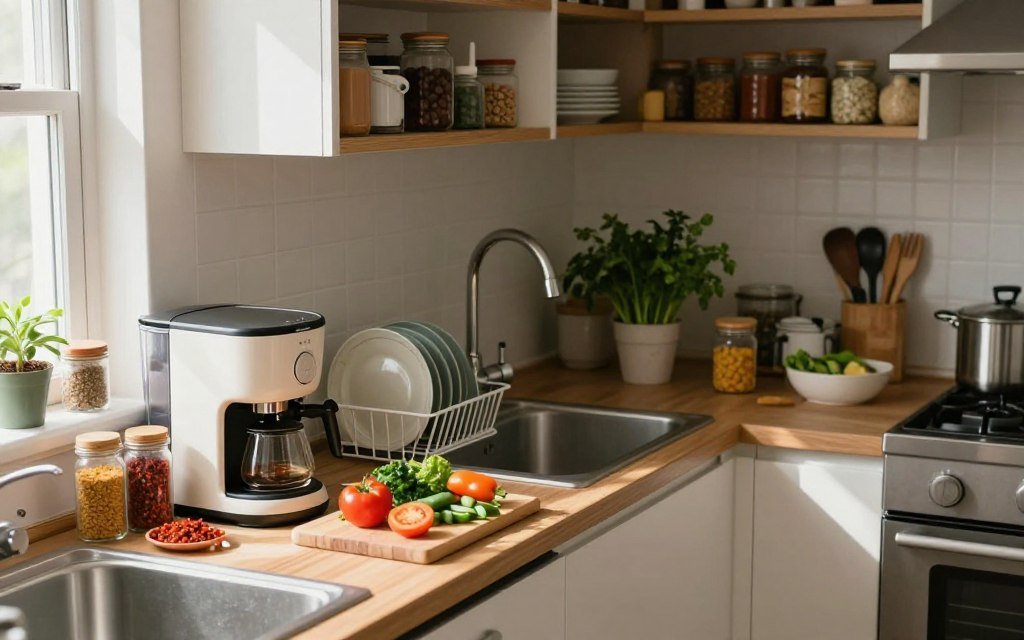
The Great Relocation (Decluttering with Purpose)
You cannot organize your way out of having too much stuff on the counter. It’s time to evict the squatters.
The “Weekly Use” Rule
Look at every single item on your counter. Ask yourself: Have I used this in the last 7 days?
- Yes: It earns its spot (e.g., coffee maker, knife block, daily spice blend).
- No: It gets relocated. Your stand mixer, slow cooker, and bulky food processor belong in a lower cabinet or pantry, not on your prime workspace.
Group by “Point of Use”
Stop storing things where they “fit” and start storing them where you use them.
- Spatulas, whisks, and cooking oils live in the drawer or on the wall next to the stove.
- Mugs and coffee filters live next to the coffee maker.
This eliminates the annoying shuffle of carrying items across the kitchen while your hands are full.
Hack the Vertical & Hidden Space
When you can’t build out, you must build up, down, and into the gaps. Floor space is a myth, we are mining for hidden capacity.
1. Mine the Walls
- Magnetic Knife Strips: Get those bulky, space-hogging knife blocks off the counter. A magnetic strip on the backsplash keeps blades sharp, visible, and safely out of the way.
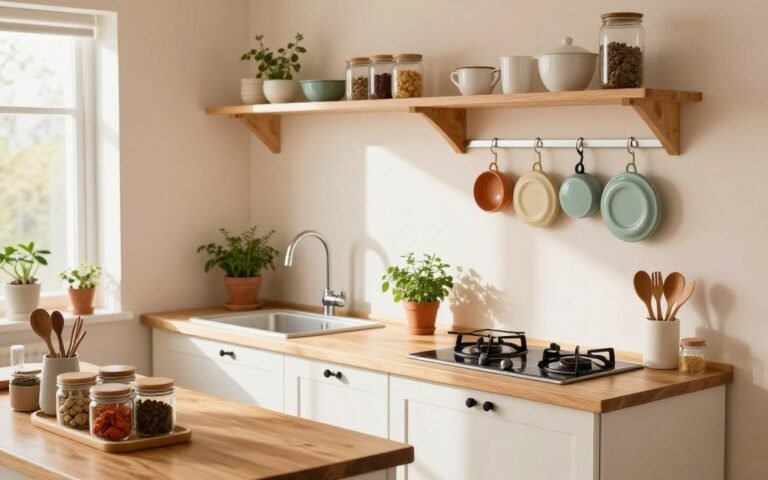
- Wall-Mounted Rails: Install a simple rail system with S-hooks to hang measuring cups, ladles, and even small pots. It’s highly functional and adds a professional chef vibe to your kitchen.
2. Optimize the “Dark Abyss” of Lower Cabinets
Lower cabinets often become black holes. Fix this by:
- Installing pull-out sliding baskets: This brings items in the very back right to your fingertips.
- Using shelf risers: Double your vertical stacking space for plates and bowls instantly.
- Adding drawer dividers: Stop the “junk drawer” chaos. Give every utensil a dedicated slot so you aren’t digging through a tangled mess.
3. Exploit the Dead Space
Got a 6-inch gap between your fridge and the wall? That’s not wasted space; that’s a home for a slim, rolling utility cart (like the popular IKEA Råskog). It’s perfect for pulling out produce or spices while you cook, and tucking away when you’re done.
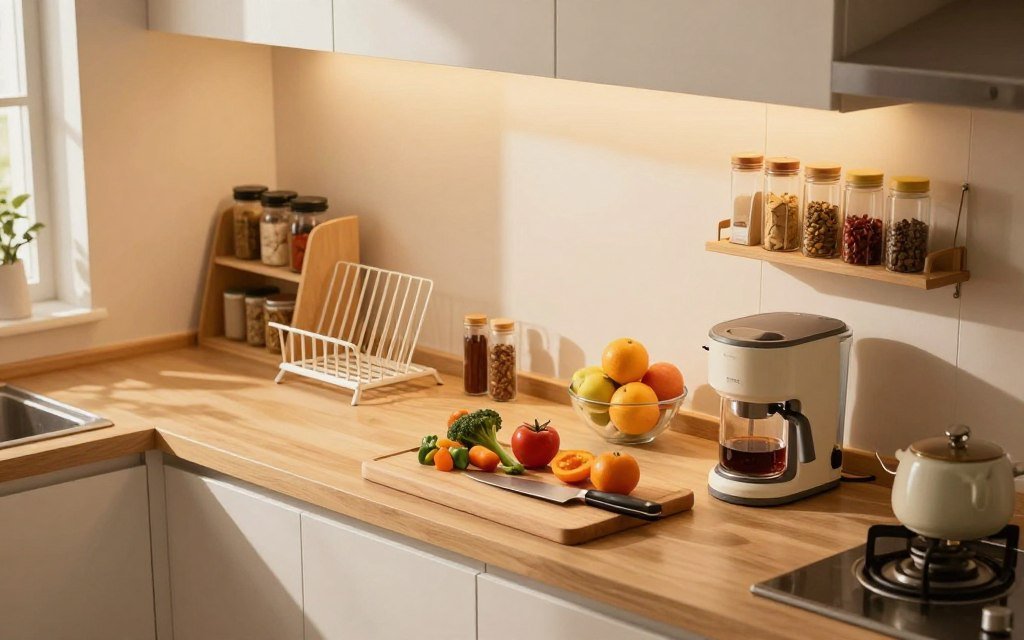
Expandable Surfaces & Long-Term Maintenance
Sometimes, you just need a little more room while you cook, without permanently losing it.
Temporary Prep Surfaces
- Over-the-Sink Cutting Boards: This is the ultimate small-kitchen hack. A custom-fit cutting board that rests securely over your sink instantly creates a sturdy, secondary prep zone.
- Stovetop Covers: Crucial safety note: Only use these when the burners are completely cold and inactive. They are great for setting down ingredients while plating, but never as a permanent surface over an active stove.
The “Clean-as-You-Go” Reset
A small kitchen will always feel cluttered if you wait until the end of the meal to clean. Make it a habit to wash bowls, wipe spills, and return tools to their designated zones while the food simmers. A 2-minute reset prevents a 20-minute cleanup nightmare.
Safety First
- Never store flammable items (like paper towels or wooden utensils) directly next to a heat-producing appliance like an air fryer or toaster oven.
- Always anchor wall-mounted shelves or heavy pot racks into wall studs, not just drywall.
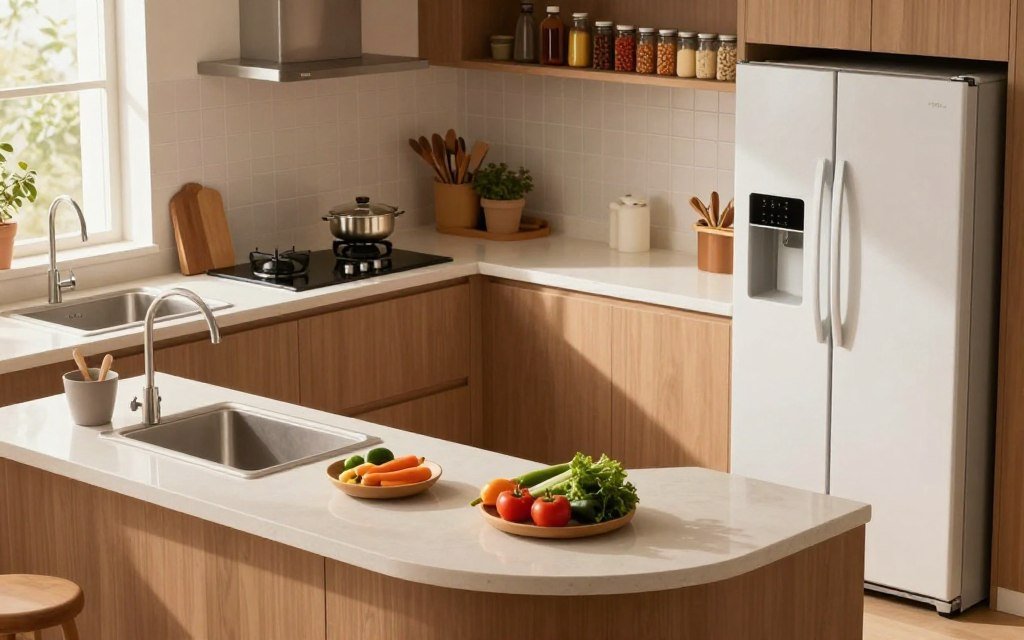
Quick FAQ: The Small Kitchen Cheat Sheet
How do I apply the “work triangle” in a tiny galley or one-wall kitchen?
In a galley kitchen, keep the triangle tight to minimize steps. In a one-wall kitchen, the triangle becomes a straight line. Your priority here is vertical storage: keep prep tools on wall rails directly above or below the prep zone to keep the counter clear.
What is the most effective way to hide small appliances?
Sort them by frequency. Daily items stay out. Weekly items go on lower, easily accessible shelves. Seasonal or monthly items (like a holiday cookie press or a massive stand mixer) go to the top shelf of a pantry or a high cabinet.
Are there temporary ways to add counter space without drilling?
Absolutely. An over-the-sink cutting board is the best immediate fix. A narrow, rolling kitchen cart is the second best, as it provides extra surface area and storage, and can be wheeled into a closet when not in use.
How can I stop “countertop creep” (when cabinets get full and stuff migrates to the counter)?
Uniformity is your friend. Decant dry goods (pasta, rice, cereal) into square, stackable, airtight containers (like OXO Pop containers). Square containers pack tightly together, eliminating the wasted air space that round bowls create, freeing up massive amounts of cabinet room.
How do I make a small kitchen feel less cramped visually?
Clear the visual noise. Limit open shelving to a few matching, attractive items (like nice glass jars or a single plant). Hide the mismatched, cluttered items behind closed cabinet doors. Use under-cabinet LED lighting to brighten the workspace without taking up a single inch of surface area.