How to Choose a Dining Table for a Small Space
We’ve all been there. You invite a few friends over for dinner, and suddenly your cozy dining nook feels like a contact sport. Someone’s elbow is in the salad, someone else is doing the sideways shuffle to get to the kitchen, and you’re silently regretting that “compact” table you bought online.
In a small home, a dining table has to work overtime. It’s for meals, remote work, craft projects, and hosting. The secret to getting it right isn’t just buying the smallest table you can find. It’s about mastering proportions, clearances, and your actual daily habits.
Here is your no-nonsense, designer-approved guide to choosing a dining table that makes your small space feel intentional, comfortable, and surprisingly spacious.
1: The Tape Measure Reality Check
The biggest mistake people make is measuring the empty spot on the floor and forgetting about the human bodies and chairs that need to occupy that space.
Before you shop, map out the real footprint:
- The Comfort Zone: You need about 36 inches (91 cm) from the edge of the table to the nearest wall or piece of furniture to pull out a chair and sit comfortably.
- The “Squeeze” Zone: In truly tiny apartments, you can get away with 30 inches (76 cm), but anything less will feel claustrophobic.
- The Walkway Rule: If people need to walk behind seated diners to get to the kitchen or balcony, you need 44 to 48 inches (112–122 cm) of total clearance.
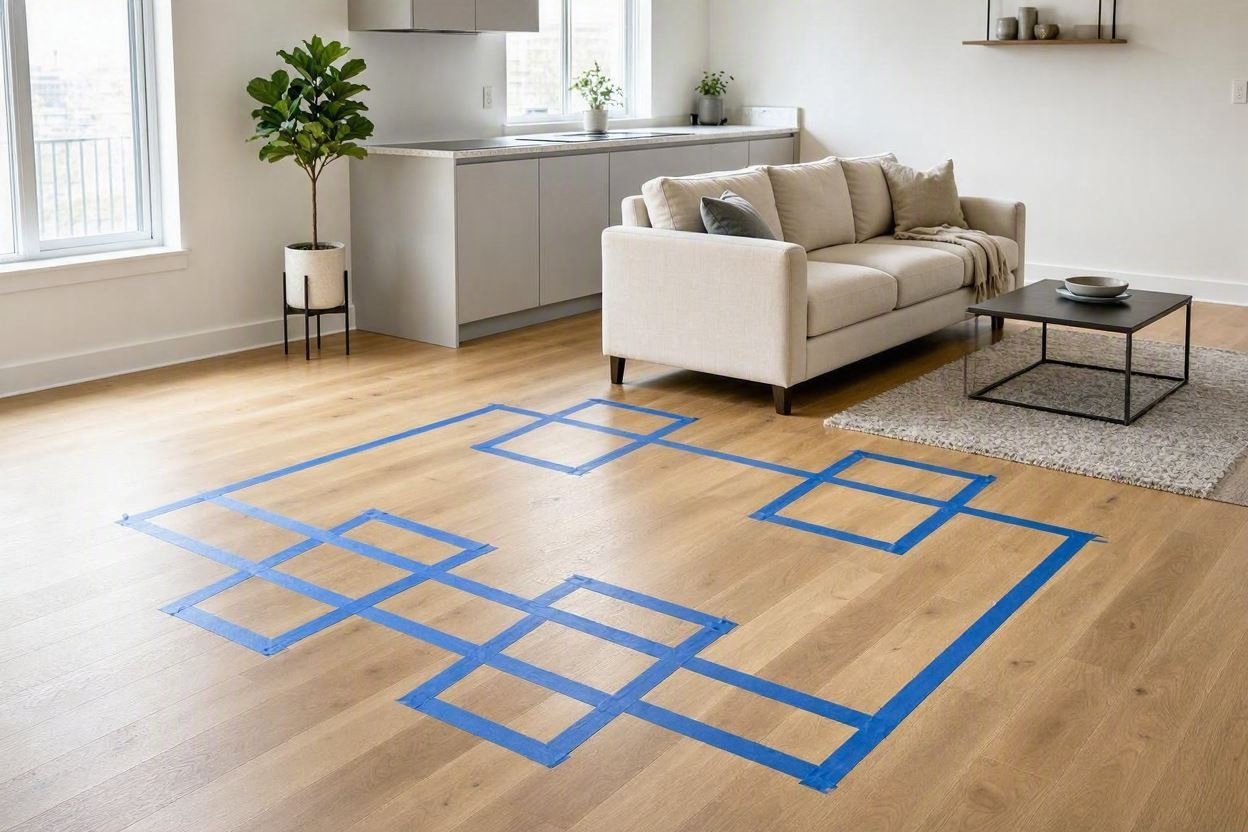
The Designer’s Trick: Don’t guess. Use blue painter’s tape to mark the exact footprint of the table and the pulled-out chairs on your floor. Live with the tape for 24 hours. If you find yourself constantly navigating around it, the table is too big.
2: Shape Dictates Flow
In small spaces, the shape of the table matters far more than its style or color.
- Round Tables: The ultimate small-space hero. They have no sharp corners to bruise your hips, they improve traffic flow, and they make a tiny square nook feel open. (Just be careful: a round table’s footprint grows quickly, so keep the diameter under 42 inches for tight spaces).
- Rectangular Tables: Best for narrow, galley-style rooms or open-plan spaces. They align perfectly with walls, but those sharp corners can choke a walkway if you aren’t careful.
- Oval Tables: The best of both worlds. You get the seating capacity of a rectangle, but the curved ends allow for much smoother movement around the room.
- Square (Bistro) Tables: Perfect for 1–2 people daily in a tiny corner, but they become incredibly awkward the moment you try to squeeze in a third or fourth person.
3: Size for Tuesday, Not Thanksgiving
A small-space dining table should be sized for how you eat most days, not the one or two holidays a year you host a crowd.
- For 2 people daily: A 24–30 inch round or small square table is plenty.
- For 4 people daily: Look for a 36–44 inch round table, or a compact rectangle (around 30″ x 48″).
- The 24-Inch Rule: Plan for roughly 24 inches of width per person along the edge of the table. You can squeeze tighter, but comfort drops off a cliff.
If you host 6+ people occasionally, do not buy a permanently large table. Invest in an expandable solution instead.
4: The Secret Comfort Killer (Table Bases)
You can have the perfect tabletop, but if the base is wrong, the table will be a daily frustration. Leg placement dictates comfort.
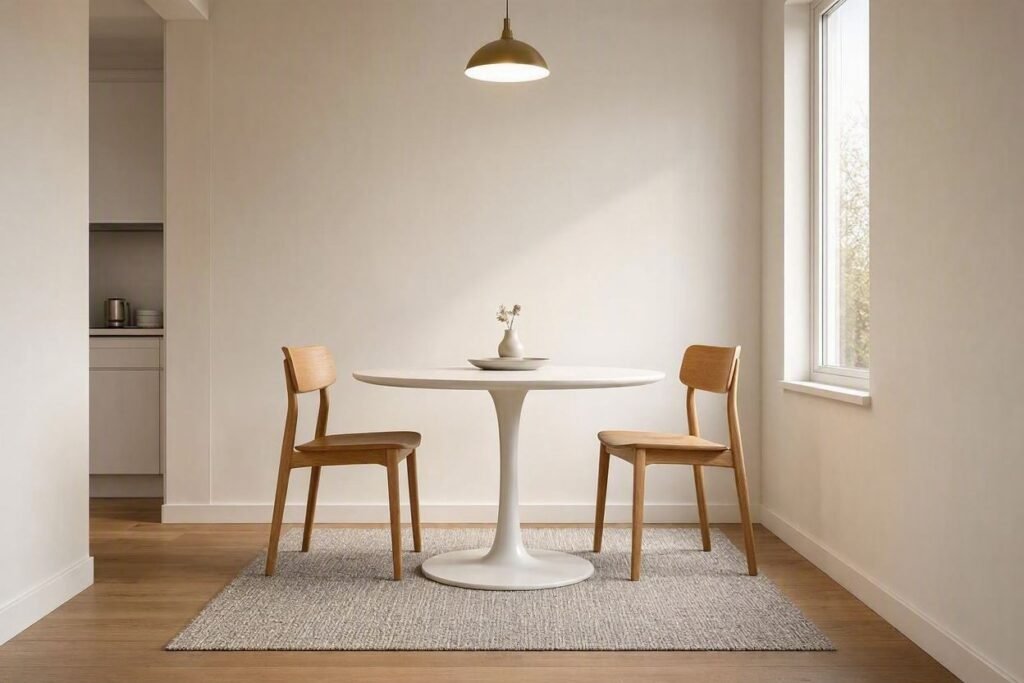
- Pedestal Base (The Winner): A single central column is the gold standard for small spaces. It eliminates knee collisions and allows chairs to be tucked in or pulled out from any angle without hitting a leg.
- Four Legs at the Corners: Classic and stable, but it makes the seats at the very ends of the table incredibly awkward to use, effectively reducing your seating capacity.
- Trestle Base: Great for longer rectangular tables, but ensure the side supports are set far enough back so they don’t block your guests’ feet.
5: Expandability and Visual Weight
When square footage is limited, your table needs to be a shape-shifter, and it needs to look light.
- The Expandable “Secret Weapon”:
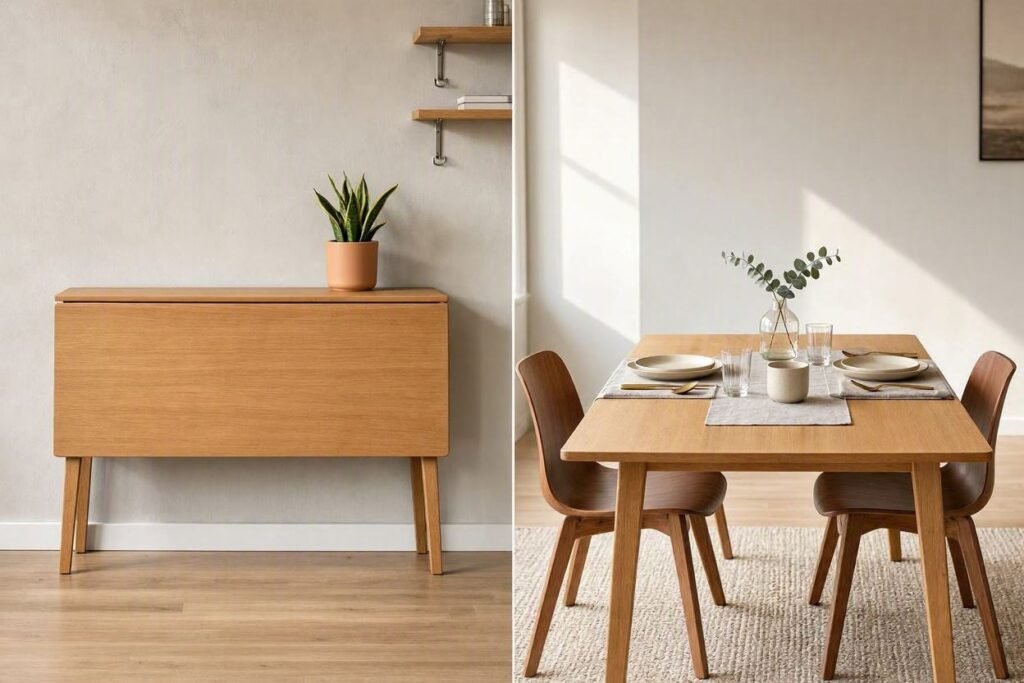
- Drop-leaf or Gateleg: Folds down flat against a wall when not in use (e.g., the classic IKEA INGATORP or West Elm Mid-Century Expandable).
- Butterfly Leaf: A leaf stored under the table that pulls out seamlessly.
- Crucial Check: Always measure the table fully extended to ensure you still have a walkable path through the room.
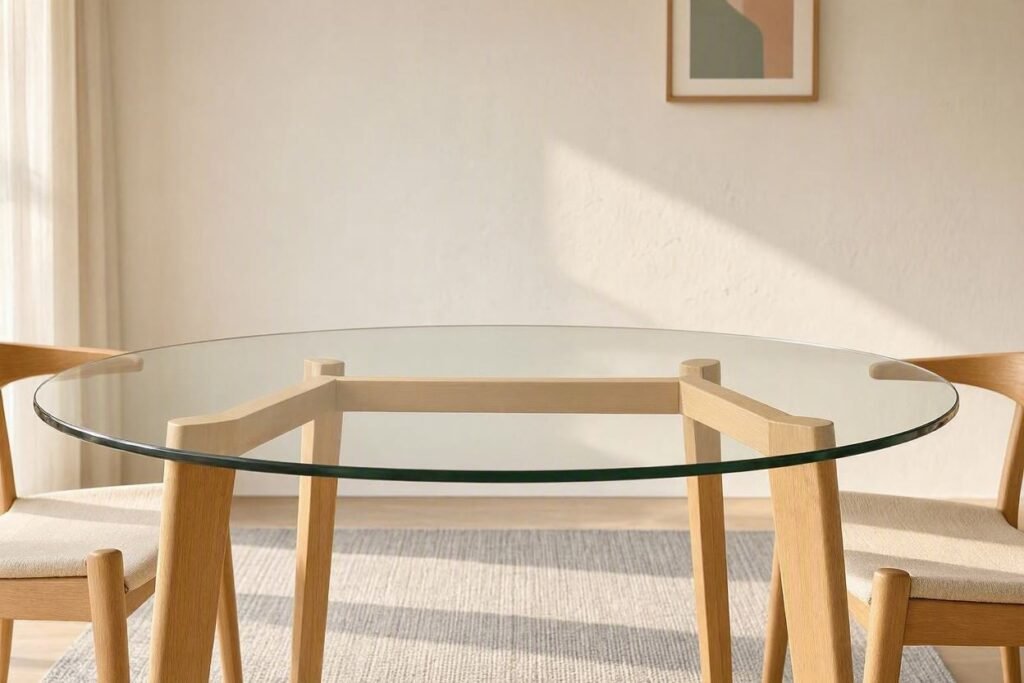
- Visual Lightness: A chunky, dark wood slab will make a small room feel heavy. Opt for glass tops (which disappear visually, though they show fingerprints), light wood tones (like oak or ash), or tables with slender, tapered legs.
6: Don’t Let the Chairs Ruin the Table
Half of all “table problems” in small spaces are actually chair problems.
- Go Armless: Armchairs are space-hogs. Armless chairs slide in and out effortlessly and can be tucked completely under the table.
- The Bench Hack: A bench pushed against a wall saves massive amounts of space because it eliminates the “pull-out” clearance needed for individual chairs. (Pro tip: Choose a bench with a slim profile, and add a cushion for long-term comfort).
- Stackable/Folding: Keep two stylish folding chairs (like the IKEA TERJE) in a closet for when guests arrive, rather than letting them permanently occupy floor space.
Quick Reference: Which Table Fits Your Life?
| Table Type | Best For | The Vibe | Watch Out For |
|---|---|---|---|
| Small Round Pedestal | Tight nooks, square areas | Smooth traffic flow, flexible seating | Can feel bulky if the diameter exceeds 42 inches. |
| Drop-Leaf / Wall-Friendly | Studios, multipurpose rooms | Collapses to almost nothing when not in use. | Can feel slightly wobbly at max extension. |
| Compact Rectangle | Narrow rooms, open plans | Seats 4 efficiently along a wall. | Sharp corners can block walkways; plan carefully. |
| Oval Table | Softening a rectangular footprint | Better movement than sharp corners. | Harder to find in truly compact, apartment-sized dimensions. |
| Square Bistro | 1–2 people daily | Tiny footprint, cozy coffee-shop vibe. | Hosting more than 2 people is a physical struggle. |
| Extendable (Butterfly Leaf) | Hosts occasionally | Small daily footprint, expands cleanly. | Requires storage space for extra leaves (if not self-storing). |
The “No Regrets” Pre-Purchase Checklist
Before you click “Add to Cart” run through this reality check:
- You’ve taped the footprint on the floor and tested the chair pull-out space.
- You can still walk through the room (especially behind seated diners) without turning sideways.
- The table base (preferably pedestal) won’t fight your knees or block chairs.
- The size fits your daily life (2–4 people), with an expandable option for rare occasions.
- You’ve chosen armless chairs or a space-saving bench to complete the setup.
A small dining area doesn’t have to feel like a compromise. When the proportions are right, the base is smart, and the clearances are respected, your dining spot will work beautifully every single day not just look good in a showroom photo.